Sri Lanka waives tourist visa fees for 40 nationalities from May 2026
Sri Lanka has eliminated tourist ETA fees for visitors from 40 countries, effective May 2026. Short-stay travelers from eligible nationalities can now obtain an ETA at no cost.
Neutralized, source-linked updates from nomad, tax, migration, and remote-work sources.
158 items
Sri Lanka has eliminated tourist ETA fees for visitors from 40 countries, effective May 2026. Short-stay travelers from eligible nationalities can now obtain an ETA at no cost.
Switzerland lifted visa restrictions on Ethiopian nationals that had been in place since April 2024, with the Federal Council adopting the measure on June 12, 2026. The decision followed the EU Council's move to reinstate certain visa requirements for Ethiopia in response to improved cooperation from the country.
Effective June 12, 2026, Ireland updated its non-EEA Family Reunification Policy, including changes affecting Irish nationals and certain non-EEA nationals. General Employment Permit holders and other Category C sponsors are now required to submit additional supporting documentation.
Kazakhstan has confirmed that nationals from 105 countries are eligible to obtain an electronic visa without visiting an embassy. The e-visa system allows entry without in-person consular appointments, subject to eligibility and stay duration rules.
The UK government has launched a Visa Fees Reimbursement Scheme for scale-up businesses operating in the Clean Energy, Life Sciences, and Digital and Technologies sectors. The scheme covers eligible visa fees incurred on or after June 9, 2026.
Effective June 9, 2026, the Philippines Department of Labor and Employment (DOLE) has centralized all processing, evaluation, and issuance of Alien Employment Permits (AEPs) at the DOLE Central Office under Administrative Order No. 199 of 2026. All DOLE Regional Offices have immediately ceased accepting or processing both new and renewal AEP applications.
From June 9 to December 31, 2026, individuals in Canada who have applied for permanent residence under the Provincial Nominee Program may submit alternative proof of PR submission instead of an Acknowledgment of Receipt when applying for a work permit. Officers are authorized to temporarily accept this alternative evidence during this period.
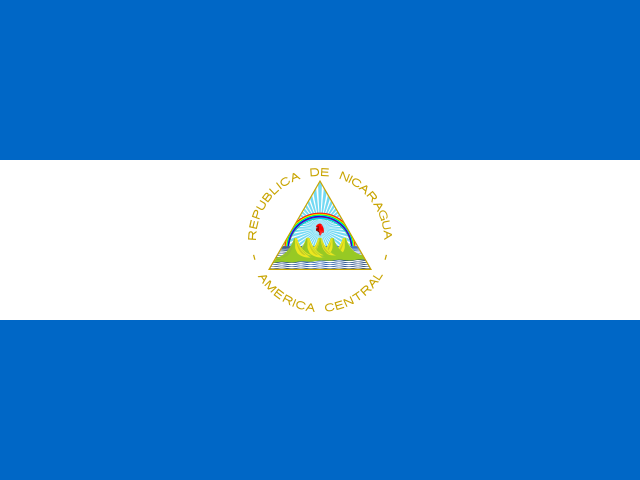
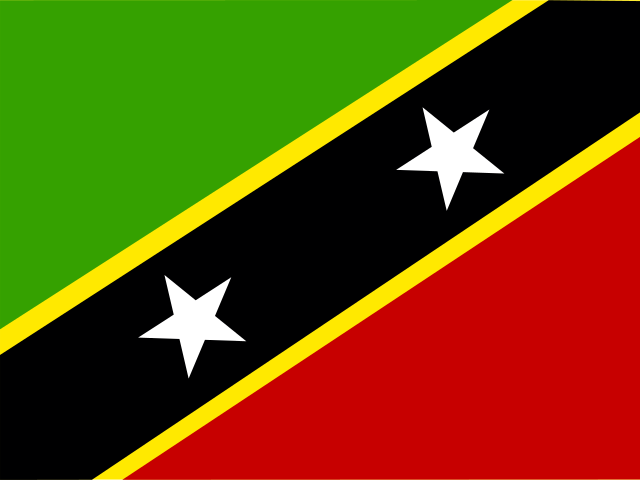
From June 15, nationals of Saint Kitts and Nevis, Saint Lucia, and Nicaragua will require a visa to enter Ireland. The change follows a similar move by the UK and coincides with a broader EU tightening of policy toward golden passport programs.
The U.S. Department of State confirmed that as of June 5, 2026, all available EB-5 unreserved immigrant visas chargeable to India have been issued for fiscal year 2026. U.S. embassies and consulates can no longer issue EB-5 unreserved visas to Indian applicants for the remainder of FY 2026.
Hungary's National Directorate for Aliens Policing (OIF) will no longer accept new guest worker residence permit applications effective June 6, 2026. Applications submitted by June 5, 2026 with the administrative fee paid will still be processed, and existing permit holders may still apply for extensions.
Effective June 9, 2026, the Philippines Department of Labor and Employment (DOLE) transferred all Alien Employment Permit (AEP) processing from regional offices to the DOLE Central Office under the Bureau of Local Employment (BLE), per Administrative Order No. 199 issued June 8, 2026. Regional offices will no longer handle AEP applications.
The FIFA World Cup 2026 begins June 11, with Dallas among the host cities. Travelers attending the tournament should be aware of immigration entry requirements and preparation steps for visiting the United States.
Effective May 30, 2026, all nine existing Ontario Immigrant Nominee Program (OINP) streams have been revoked as Ontario transitions to a redesigned immigration framework aimed at aligning with labour market needs. New draws across all streams are paused while the replacement framework is prepared for launch.
The US Department of State has issued a temporary final rule adding an optional $750 expedited interview fee for B1/B2 visa applicants, effective July 1 through December 31, 2026. Eligible applicants who pay the fee can secure an interview appointment within 10 business days, subject to availability.
A US federal court ruled on June 8, 2026 that the Trump administration's $100,000 fee requirement on certain H-1B petitions is unlawful. The decision has immediate implications for employers sponsoring H-1B workers and the broader future of the fee policy.
A US federal court ruled on June 8, 2026 that the Trump administration lacked authority to impose a $100,000 fee per H-1B visa petition, vacating the policy immediately. The decision was issued by US District Judge Leo Sorokin in Boston.
USCIS opened a new Asylum Office in San Antonio, Texas, effective May 28, 2026, to increase interview capacity for affirmative asylum applications. Applicants within the Houston Asylum Office jurisdiction may now be scheduled for interviews at either the Houston or San Antonio location.
Effective June 5, 2026, IRCC expanded a temporary measure originally announced March 13, 2026, allowing eligible Quebec workers to obtain employer-specific work permits under the International Mobility Program to continue working for their current employer.
Quebec's MIFI has updated its guidelines for Certificat d'acceptation du Québec (CAQ) for Studies applications involving dependent children. Under the new guidance, dependent children requiring a CAQ for Studies may only submit their application after the principal applicant's work permit process has advanced to a specified stage.
A federal judge in Rhode Island struck down a Trump administration DHS policy on June 5, 2026 that had suspended adjudication of asylum applications, work permits, green cards, and citizenship applications for nationals of approximately 39 countries. The court order blocks the policy, restoring processing of those immigration benefits for affected applicants.
New US travel restrictions and immigration policy changes may affect foreign nationals from certain countries traveling during summer 2026. Employers and global workforces are advised to review current entry requirements and policy updates before travel.
The U.S. Department of Homeland Security has proposed a rule that would significantly limit access to Employment Authorization Documents (EADs) for parolees, deferred action recipients, and individuals with final removal orders. The proposal is framed as an effort to reduce unauthorized employment and prioritize U.S. workers.
Sierra Leone's Ministry of Information and Civic Education announced a nationwide verification exercise for foreign nationals beginning June 1, 2026, covering residence permits, work permits, and non-national identity cards. A taskforce will conduct inspections at workplaces and businesses to verify compliance.
From June 1, 2026, enterprises, representative offices, and registered organizations in Vietnam must use Business VNeID to access government online portals for immigration procedures. The previous login method using a company e-signature or token has been discontinued with no transition period.
As of June 1, 2026, South Korea's Ministry of Justice raised the quota for E-7-4 skilled foreign workers in agriculture, livestock, and fisheries to 50% of the workforce. The change is intended to address labor shortages in those rural sectors.
From June 2026, South Korea's Top-Tier Visa now covers professors and researchers in science and technology, following a joint announcement by the Ministry of Justice and Ministry of Science and ICT on May 31, 2026. The visa had previously been restricted to employees at companies in eight high-tech industries including semiconductors.
Qatar's Ministry of Interior has announced that automatic extensions of expiring or expired entry visas will cease on June 7, 2026. From that date, standard procedures and validity periods for all entry visa types will apply.
From June 1, 2026, Immigration New Zealand has temporarily reduced visitor visa fees for Pacific nationals from NZD 216 to NZD 161 (including the NZD 41 immigration levy). The reduction is in effect for 12 months.
New work permit rules took effect in Sweden on June 1, 2026, affecting employers hiring non-EU/EEA nationals. Changes include a new salary requirement and expanded grounds for the Swedish Migration Agency to reject applications.
From June 1, 2026, Immigration New Zealand moved family of temporary visa holder applications to its enhanced Immigration Online platform. The system has been rolling out in phases since 2021, with international student visas among the application types already transitioned.
Your feedback has been submitted. We read every message.
You've reached the page limit for guests. Signing up is free.
Already have an account? Log in